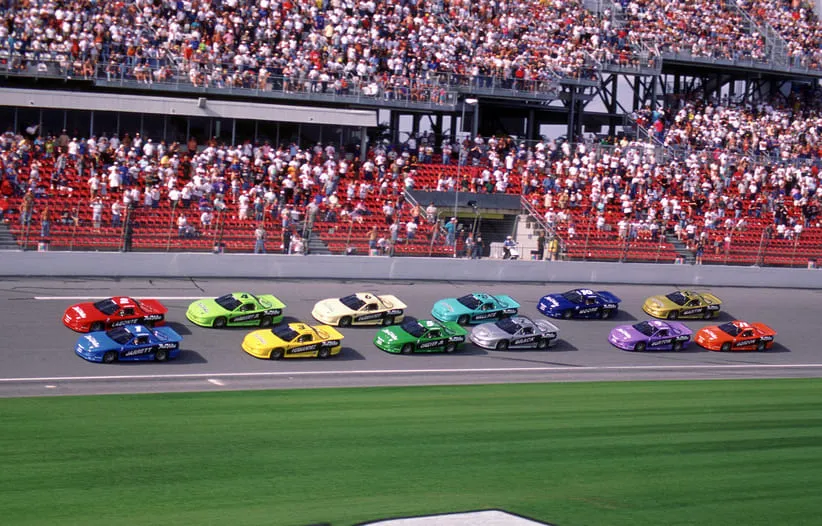
The racing world just got a jolt of old‑school energy. NASCAR Hall of Famers Jeff Gordon and Kurt Busch are officially part of the driver lineup for the upcoming IROC Heritage Invitational, and the announcement has already stirred up interest across the industry.
For fans who grew up watching the International Race of Champions, this isn’t just another exhibition. It’s the return of a format that put the spotlight squarely on the driver. The event, presented by Chevrolet, will run under the Ten Tenths Motor Club banner on Friday, April 10, in Concord, North Carolina.
A Historic Reunion of Racing Veterans
Seeing Jeff Gordon back in an IROC car carries weight. Gordon didn’t just participate in the series he excelled in it. During his run from 1995 to 2000, he consistently put himself in contention against champions from every major discipline. His résumé speaks for itself: four NASCAR Cup Series championships, 93 Cup wins, three Daytona 500 victories.
This level of adaptability made him dangerous in any car he touched. Gordon’s smooth inputs and calculated aggression were tailor‑made for IROC’s equal‑equipment format, and seeing him return to that environment brings back a style of competition that defined his prime. Kurt Busch brings a different kind of edge.
The 2004 Cup champion entered IROC in 2003 and immediately won the championship in his first attempt. This is something very few drivers have ever done. Busch built his career on versatility and toughness, winning 34 Cup races, the 2017 Daytona 500, and competing in both the Indy 500 and Coca‑Cola 600 on the same day.
His ability to adapt to different machinery and his willingness to push the limit made him a natural fit for IROC then, and it makes him a legitimate threat now. They’re not alone. The rest of the field reads like a cross‑section of motorsports history.
A Field Packed With Champions
1. Mark Martin
Mark Martin remains the benchmark of the entire series. Five IROC championships, 40 Cup wins, and a reputation for precision that few drivers have ever matched. Martin’s dominance in IROC wasn’t a fluke. He understood how to extract speed from equal cars better than anyone else. His return instantly raises the competitive bar.
2. Bobby Labonte
Bobby Labonte brings a different style. The 2000 Cup champion built his career on consistency and racecraft rather than aggression. With 21 Cup wins, an Xfinity championship, and a reputation for being one of the smoothest drivers of his era, Labonte thrived in formats that rewarded patience and technical skill. IROC suited him well, and it still does.
3. Ken Schrader
Ken Schrader is the definition of a pure racer. He’s run everything from Cup cars to dirt modifieds to ARCA machines, often in the same week. Schrader’s career includes four Cup wins, multiple USAC championships, and thousands of short‑track starts across the country. His adaptability and mechanical feel made him a natural fit for IROC, and he remains one of the most respected all‑around drivers of his generation.
4. Scott Pruett
Scott Pruett brings the road‑racing pedigree. A five‑time IMSA champion, three‑time Rolex 24 winner, and former CART competitor, Pruett was always the driver stock‑car racers had to worry about when the IROC schedule hit a road course. His ability to transition between sports cars, open‑wheel machines, and stock cars made him one of the most versatile drivers in the field.
5. Max Papis
Max Papis adds intensity and experience from nearly every corner of the racing world. With wins in IMSA, CART, and sports cars, plus a stint in NASCAR, Papis built a reputation on passion and adaptability. His background in high‑downforce machinery gave him a unique approach to IROC cars, and his return adds depth to the field.
6. Tommy Kendall
Tommy Kendall dominated the Trans Am Series in the 1990s, winning four championships and becoming one of the most successful road‑racing drivers in American history. Kendall’s smooth, analytical style translated well to IROC machinery, and his presence brings another layer of technical expertise to the grid.
7. Tomy Drissi
Tomy Drissi rounds out the group with decades of Trans Am experience and a reputation for being a tough competitor. Drissi has multiple wins across the series and has competed in sports cars, stock cars, and prototypes. His familiarity with high‑horsepower, low‑downforce cars makes him a natural fit for the IROC platform.
Why the IROC Heritage Invitational Matters
IROC was built on a simple idea: put the best drivers in identical cars and see who rises to the top. From 1973 to 2006, it was the closest thing motorsports had to a true driver‑versus‑driver test. No engineering advantages. No manufacturer politics. No excuses.
The Heritage Invitational aims to bring that philosophy back. The field will feature authentic IROC machines, restored and prepared to reflect the era in which they were used, from 1974 to 2006. For a few hours in Concord, these cars will be pushed again by the drivers who helped define the series.
Adding to the event’s credibility, Al Unser Jr. will serve as an ambassador. A two‑time CART champion, two‑time Indy 500 winner, and IROC champion himself, Unser’s involvement connects the revival to the era when the series regularly featured the best drivers from every major discipline.
What This Means for the Sport
The return of the IROC name, even in invitational form, reflects a renewed interest in driver versatility. Modern racing often funnels drivers into a single discipline early, but IROC was built on the idea that the best drivers should be able to compete in any discipline.
Gordon and Busch signing on reinforces that idea. It shows that the drivers themselves value this format. They miss the challenge of playing on equal equipment, the respect earned from beating champions from other series, and the straightforward nature of the competition.
For newer fans, this event offers something rare: a chance to see drivers they’ve only watched in highlights actually compete again, in cars that demand skill rather than simulation‑driven precision.
What’s Next
The IROC Heritage Invitational is shaping up to be one of the most meaningful events of the spring. A field featuring Jeff Gordon, Kurt Busch, Mark Martin, Bobby Labonte, and others doesn’t come together often. This April, Concord will host a gathering of drivers who built their reputations on adaptability and raw ability.
For the competitors, it’s another chance to measure themselves against familiar rivals. For fans, it’s an opportunity to see a piece of racing history come back to life. If you follow motorsports for the competition rather than the presentation, this is an event worth paying attention to.