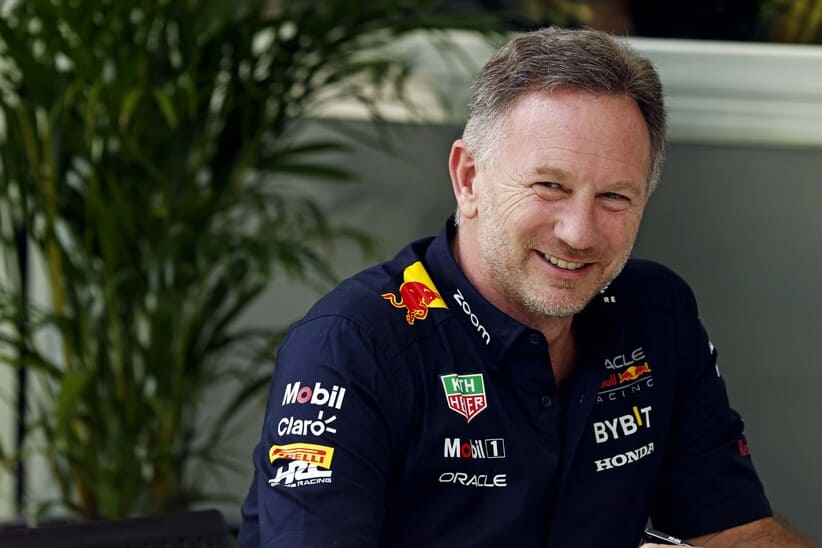
The paddock never stays calm for long, especially in Formula 1. Only months after his exit from Red Bull Racing, Christian Horner is already maneuvering for a return to the Formula 1 grid and not as an employee. The move looks deliberate and calculated, aimed at buying his way back into the sport he shaped for two decades.
His target: Alpine, a team starving for direction but possibly unprepared for the level of disruption Horner brings with him. Reports circulating in the garage suggest that Horner is part of an investment group seeking to acquire the 24 percent stake in Alpine currently held by Otro Capital. This isn’t a comeback built on a job title or a headset. This is about equity. Influence. Control.
Horner Eyes Equity and Control
For someone who spent twenty years building Red Bull into a championship‑winning machine, returning in a subordinate role was never realistic. According to ESPN and other outlets, Alpine boss Flavio Briatore has confirmed that discussions are underway but the negotiations aren’t happening at the team‑principal level.
They’re happening among shareholders. Horner is bypassing the pit wall entirely and heading straight for the boardroom. The stake he’s targeting belongs to Otro Capital, the group that brought in celebrity investors like Ryan Reynolds and Anthony Joshua. But star power doesn’t fix a slow car.
Alpine finished last in the 2025 Constructors’ Championship. They need leadership with a track record of winning, and Horner has eight drivers’ titles and six constructors’ titles to his name. He knows how to build a competitive structure from the ground up.
The timing, however, is complicated. Former driver and pundit Ralf Schumacher claims the deal is essentially done, but Horner may not appear in Alpine gear until late next year. The delay isn’t financial, it’s personal and political, tied to the personalities already on the team.
A Clash of Egos in the Garage
The biggest obstacle isn’t the money. It’s the people involved. Flavio Briatore has been steering Alpine since Oliver Oakes’ abrupt departure. Briatore is a force of nature in Formula 1 and a man known for his uncompromising control and his unwillingness to share authority. He has spent decades shaping teams through sheer force of personality.
Schumacher noted that Briatore “won’t be happy” about Horner’s arrival. And he’s right. If Horner buys a quarter of the team, he won’t be a silent partner. He’ll want to be present. He’ll want influence. Nobody buys that much of a race team to sit at home and watch timing screens.
This sets up a potential power struggle inside the Enstone operation. Briatore has been consolidating control, and Horner’s arrival threatens that directly. These are two of the strongest, most polarizing figures in modern Formula 1. Putting them under the same roof will either produce a ruthless, effective leadership structure or tear the place apart.
The Toto Wolff Factor
There’s another layer to this situation that makes the whole thing even more volatile. Alpine is set to run Mercedes engines. That means the team must work closely with Toto Wolff. The relationship between Horner and Wolff is infamous.
Their rivalry during the Hamilton‑Verstappen era was one of the most hostile managerial battles the sport has seen. The idea of Horner relying on Wolff for power units is almost surreal, yet that’s the reality Alpine is walking into.
Schumacher hinted that Alpine wants to stabilize its partnership with Mercedes before adding Horner to the mix. It’s not hard to see why. Introducing Horner into a Mercedes‑powered team is like tossing a lit match into a room full of fumes.
What This Means for the Grid
If this deal goes through, it confirms that Christian Horner isn’t finished. His exit from Red Bull was messy, driven by internal investigations, political infighting, and a fractured leadership structure that ultimately forced him out. Many assumed he’d take the payout and disappear. Instead, he’s preparing to reenter the sport on his own terms.
For Alpine, the move could be transformative or destructive. The team is struggling with pace, direction, and identity. Horner brings immediate credibility and a proven blueprint for building a winning organization. But he also brings political weight, controversy, and a personality that doesn’t blend quietly into existing structures.
Formula 1 brings back one of its most influential figures. Horner generates storylines. He creates tension. He forces reactions. His presence alone changes the tone of a race weekend.
What’s Next
What we’re watching is a high‑stakes power play involving money, influence, and pride. Christian Horner is trying to buy his way back into relevance and possibly redemption. He wants to prove he can take a broken team and rebuild it, just as he did with Red Bull two decades ago.
The real question is whether Alpine can withstand the collision of egos between Horner and Briatore. If they manage to coexist, they have the combined experience to pull the team out of the bottom of the standings. If they can’t, the internal conflict could finish off what’s left of the French outfit. One thing is certain: if Horner returns, the paddock won’t stay quiet.