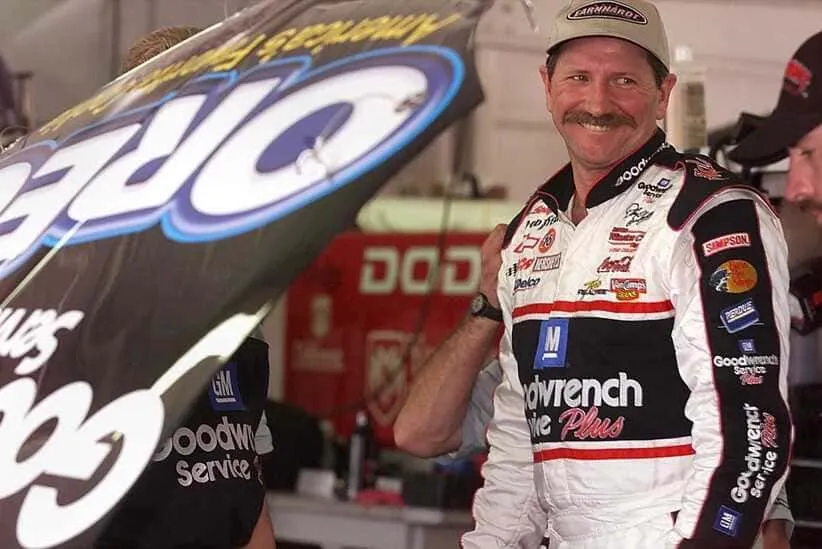
There is something special about the Cook Out Clash. It’s the wake‑up call after a long winter nap, the smell of burnt rubber finally returning to the air, and the first time we see paint schemes trading paint in anger. But for a select few, that exhibition trophy wasn’t just a preseason confidence boost. It was a harbinger of history.
Winning the Cookout Clash, formerly the Busch Clash, Bud Shootout, and Sprint Unlimited, is tough enough. But parlaying that momentum into a season‑long grind to hoist the Bill France Cup? That puts you in rare air.
Only a handful of wheelmen have managed to pull off the Winnersw double, taking home the exhibition hardware and the season championship in the same year. Let’s take a look at the legends who turned a preseason exhibition win into a championship campaign.
Dale Earnhardt: The Intimidator Sets The Tone
Earnhardt’s 1980 season was the moment NASCAR realized the Rookie of the Year wasn’t just a rising star. He was a generational force. His Clash win set the tone for a season built on consistency, aggression, and raw speed. In only his second full‑time year, he controlled the standings from February through November.
Key Stats: 1980
- 5 wins.
- 19 top‑5 finishes.
- 24 top‑10 finishes.
- Average finish: 8.7.
- Led the points after the Daytona 500 and never lost the lead.
- Won the championship by 19 points over Cale Yarborough.
Darrell Waltrip: Jaws Bites Back
Waltrip’s 1981 season with Junior Johnson remains one of the most dominant in the modern era. His Clash win was the first warning shot. Once the season began, the No. 11 team steamrolled the field with unmatched speed and execution. Waltrip didn’t just win races. He controlled the entire afternoon.
Key Stats: 1981
- 12 wins and is tied for the most in the modern era.
- 21 top‑5 finishes.
- 25 top‑10 finishes.
- 2,567 laps led and the most ever in the series.
- 35.2% winning percentage.
- Back‑to‑back championships followed in 1982.
The Man In Black Dominates Again
By 1986, Earnhardt and Richard Childress Racing were a fully formed powerhouse. His second Clash win was a preview of a season defined by toughness and relentless pace. He won on short tracks, intermediates, and in the grueling Coca‑Cola 600, proving he could beat anyone, anywhere.
Key Stats: 1986
- 5 wins.
- 16 top‑5 finishes.
- 23 top‑10 finishes.
- 1,646 laps led.
- Won the championship by 288 points.
The Man In Black Dominates Again
Earnhardt’s 1991 season showcased a different kind of dominance and consistency. His third Clash win foreshadowed a year where he rarely stumbled. With only one DNF and an average finish inside the top 10, he outlasted challengers like Ricky Rudd and Davey Allison through precision and discipline.
Key Stats: 1991
- 4 wins.
- 12 top‑5 finishes.
- 21 top‑10 finishes.
- Average finish: 8.6.
- Won the championship by 195 points.
The Rainbow Warrior Arrives
Jeff Gordon’s 1997 season was a masterclass in execution. His second Clash win was merely the appetizer for a ten‑win campaign that included some of the sport’s crown jewels. The Rainbow Warriors were operating at peak efficiency, and the rest of the garage spent the year chasing the No. 24.
Key Stats: 1997
- 10 wins.
- 22 top‑5 finishes.
- 23 top‑10 finishes.
- 1,960 laps led.
- Won the Daytona 500, Coca‑Cola 600, and the Southern 500.
Smoke Rises To The Top
Tony Stewart’s 2002 season wasn’t defined by overwhelming dominance. It was defined by grit. His Budweiser Shootout win signaled that the No. 20 team had speed, but the championship came from grinding out strong finishes, avoiding mistakes, and capitalizing on opportunities when they arose.
Key Stats: 2002
- 3 wins.
- 15 top‑5 finishes.
- 21 top‑10 finishes.
- 815 laps led.
- Won the championship by 38 points.
Logano Lights Up LA
Joey Logano’s 2022 season proved he thrives in new environments. Winning the first‑ever Clash at the LA Coliseum showed his adaptability with the Next Gen car. He carried that confidence through the playoffs and dominated the Championship 4 race with a near‑perfect performance.
Key Stats: 2022
- 4 wins.
- 11 top‑5 finishes.
- 17 top‑10 finishes.
- 3 poles.
- Led 187 of 312 laps in the championship race at Phoenix.
What This Means For The Sport
Momentum matters. The Clash may not award points, but it awards confidence and confidence is currency in NASCAR. A strong start validates offseason work, boosts team morale, and plants a seed of doubt in the competition before the Daytona 500 even begins.
Why Clash Winners Often Thrive
- Early proof that the offseason notebook is strong.
- Immediate team chemistry and communication.
- A psychological edge entering Speedweeks.
- A fast car in traffic is a key indicator of a strong season.
Conclusion
The correlation between winning the preseason opener and the season finale isn’t a guarantee. Infact it’s far from it. Plenty of drivers have won the Clash and gone on to have forgettable seasons.
But for legends like Earnhardt, Waltrip, Gordon, Stewart, and Logano, that first win was the spark that lit a championship fuse. As we look toward future seasons, keep an eye on whoever lifts that preseason trophy. They might just be practicing for the big one in November.