If you take a stroll through the staging lanes at any NHRA event, you’re bound to hear stories about the “good old days.” But for Dan Fletcher, those days aren’t just memories—they are a legacy he’s still actively building, one quarter-mile at a time.
Fletcher knows the score. He knows he’s never going to catch John Force’s stratospheric record of 157 wins. He also knows Force’s 16 championships are safe. But sitting there with 108 career victories, good enough for the third-most all-time, Fletcher rests easy knowing his name is etched in stone alongside the gods of the sport: Force, Greg Anderson, Frank Manzo, and David Rampy. That is the Mount Rushmore of drag racing, and Fletcher has earned his spot on the mountain.
A Competitor’s Fire Never Fades
Even with a résumé that would make any other driver jealous, Fletcher is still a racer at heart, which means he’s never fully satisfied.
“I realize it’s a big accomplishment,” Fletcher said. “But honestly? The last couple of years, I feel like I should have maybe five or 10 more wins. I’ve lost in the semi’s a lot.”
There’s a genuine human honesty in that admission. It’s the sound of a guy who still hates losing more than he loves winning. He admits that watching Greg Anderson surpass him in the win column stings a little. “That kind of bothers me,” he said. “I still think I’m good, but it’s the same story as 30 years ago. There is so much luck involved.”
From the Cubicle to the Winner’s Circle
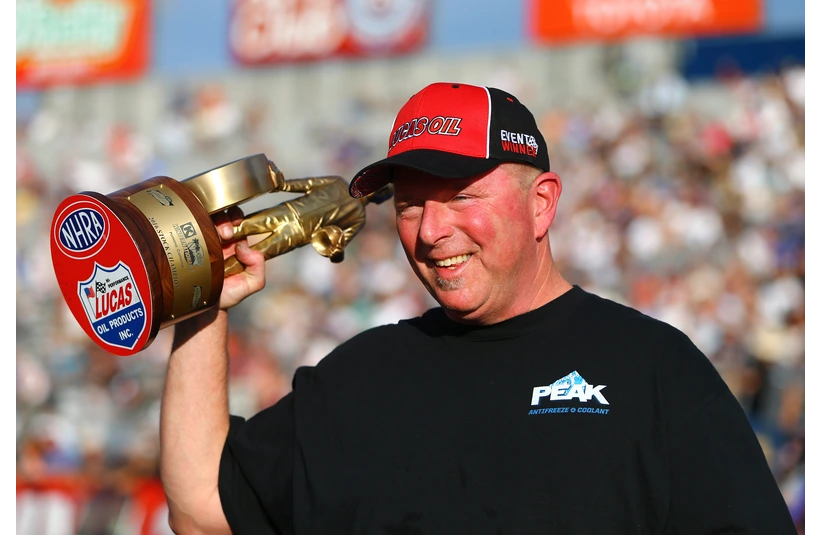
NHRA driver Dan Fletcher. Image by Mark J. Rebilas, Courtesy of Imagn
To understand Fletcher, you have to look back at the gamble of a lifetime. Picture this: It’s the mid-90s. He’s working a steady corporate gig in New York. It’s safe. It’s reliable. But the asphalt was calling.
In 1994, he won his first national event in Columbus. He took that prize money and rolled the dice on a trip to the famous Western Swing—Denver, Sonoma, Seattle. He swept them. It was a run so improbable it sounds like a movie script.
That run gave Fletcher the confidence to do what everyone told him was crazy: quit the job, pack up the family, and become a professional drag racer in 1997. Looking back, does he regret trading the suit for a fire suit?
“In a heartbeat,” Fletcher said. “I caught lightning in a bottle. I don’t think there’s any way you could do what I did today, but back then, I found a way to make it work.”
The Fletcher Family Business
The “Checkmate” ’69 Camaro isn’t just a car; it’s a member of the family. It’s arguably the most successful piece of machinery in NHRA history. But for Fletcher, the wins that mean the most aren’t always his own.
He speaks with a father’s pride about his sons, Thomas and Timothy, finding their own way to the winner’s circle. There was the time he won Comp in Maple Grove while Thomas won Stock. Or more recently, when he took home the Wally at the SPORTSnationals in Georgia, and Timothy won the delayed Bristol final.
And then there are the moments that transcend the track. Fletcher recalls the time he notched his 86th win, passing the legendary Bob Glidden. “He actually called me,” Fletcher said. “I won’t ever forget that.”
Adjusting To Life In the Slow Lane
Life looks a little different for the Fletcher camp these days. The grueling schedule of crisscrossing the country for 20 national events is in the rearview mirror. After the world shifted during the pandemic, he moved from Upstate New York to North Carolina.
The move made sense. The cost of living is better, and the racing scene in the Carolinas is vibrant all year round. It allows him to stay competitive without bleeding the budget dry. “I was hurting for sponsor dollars,” he said. “Fortunately, I have great sponsors that have stuck with me because you just can’t turn on enough win lights to make this work otherwise.”
With support from long-time partners like Mickey Thompson, ATI, and Micro Strategies, he keeps the wheels turning.
Still Dangerous At the Tree
So, is Dan Fletcher slowing down? Maybe physically, he’s not racking up the frequent flyer miles, but mentally? He’s sharp as a tack.
He’s gone full circle, returning to his roots by hitting local foot brake races on Saturdays, racing for $5,000 purses and loving every minute of it. It’s not about the glamour anymore; it’s about the competition.
“I don’t win as much as I used to, but I think I’m still pretty good,” Fletcher said. “I’m not just here to participate. I go to win the race. I think I drive as well as I always have.” In a sport decided by thousandths of a second, Dan Fletcher is proving that while you can’t outrun time, you can certainly give it a run for its money.