
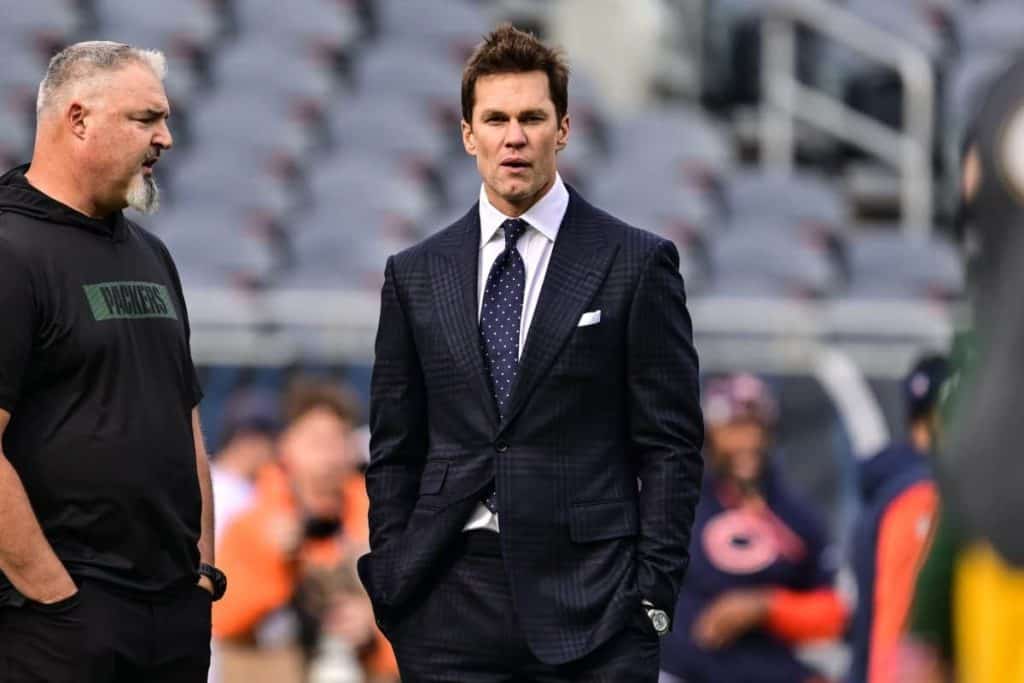
Tom Brady has been the most recognizable face in football for decades, but his present role in the game has the NFL stuck in an uncomfortable controversy. As a Las Vegas Raiders minority owner and the flagship broadcaster for Fox Sports, Brady finds himself caught between two powerful positions that seldom intersect in professional sports.
His appearance in the Raiders’ coaching booth during their 20-9 loss to the Chargers rekindled questions about whether his two-job setup constitutes an unfair conflict of interest. The issue is not Brady’s credibility, but the integrity of the league’s competitive balance and its television product.
The Conflict Of Interest Controversy
The problem is Brady’s preferential access. As a Fox broadcaster, he attends weekly production meetings with staff, where coaches and players occasionally divulge strategy, personnel moves, and even individual play plans in an atmosphere of trust. No other NFL owner gets such direct, formal access to competing franchises. For the Raiders, Brady’s involvement is definitely a bonus.
As a 23-year veteran with seven Super Bowl championships under his belt, he is an old, experienced football resource, especially for a team that has been trying to regain its footing under new management. But his involvement in Raiders affairs and Fox play-by-play comes with an unavoidable shadow of gray. Fans, players, and indeed even opposing teams wonder whether one of the all-time greatest quarterbacks now has unfair access to a competitive advantage.
The NFL’s Response
The league’s official reaction has been to remind everyone that Brady did not do anything improper by sitting in the Raiders’ coaches’ booth or wearing a headset. NFL spokesman Brian McCarthy stated that there are “no policies that prohibit an owner from sitting in the coaches’ booth or wearing a headset in a game.” The league continued that Brady was in the booth as a limited partner and not working.
Moreover, the NFL has put some limits on Brady’s dual role. He is not allowed to attend production meetings or practice in person at team headquarters, and he is required to do interviews off location or via telephone. Though these regulations attempt to keep his ownership separate from his broadcast obligations, in practice, the league is merely leaving it to each team to decide what they tell Brady in production meetings. This hands-off policy has done nothing to silence the critics.
How The NFL Missed the Mark
The NFL statement, as a matter of law, does not respond to the question. The question is not whether Brady violated existing policies—it’s whether those policies adequately safeguard competitive fairness. Allowing an owner to be an owner and a broadcaster provides him with information about competing teams that every other owner does not have. That disadvantage harms the competitive integrity of the league, along with teams’ trust in broadcasting relationships.
Furthermore, by making players and coaches determine what to disclose to Brady, the NFL puts teams in a lose-lose scenario. If they comply, they expose themselves to divulging valuable information to a competing owner. If they don’t, the broadcast remains superficial and viewers receive a less desirable experience. By attempting to play both roles for Brady, the NFL has effectively undermined both Fox’s product as well as the Raiders’ competitive integrity.
Final Thoughts
Brady’s unprecedented dual role as broadcaster and minority owner has taken the NFL to uncharted waters. Though as much as the league might wish to assume that no rules were broken, the fact is that its rules were never set down to offer a solution to an issue of this nature in the first place.
Brady isn’t plotting for the Raiders himself, directly anyway, but his talent as a broadcaster to see other teams’ covert game plans is nonetheless a naked conflict of interest. Until the NFL legislatively requires a “pick a lane” policy, the integrity of both its broadcast and its competition will always be questionable.